


When Good Lakes Go Bad: Eutrophication


When Good Lakes Go Bad: Eutrophication
Lakes rarely change all at once. In most cases, the decline occurs gradually, season by season, until algae blooms, odors, fish stress, and cloudy water become normal rather than occasional problems. I see this pattern repeatedly in lakes, ponds, and reservoirs that struggle with persistent algae issues.
That slow decline is usually driven by eutrophication. It is one of the main reasons algae problems keep recurring, even after repeated treatments. Understanding how eutrophication works is essential to effectively manage algae and maintain long-term water quality.
What Is Eutrophication?
Eutrophication happens when a waterbody receives more nutrients than it can naturally process. The nutrients involved are mainly phosphorus and nitrogen. These nutrients come from familiar sources, such as fertilizer runoff from lawns, agricultural fields, and golf courses. They also enter through stormwater flowing into lakes and retention ponds, leaking septic systems, and the buildup of organic matter in bottom sediments. When nutrient inputs continue to exceed the system's capacity, algae growth accelerates.
The word eutrophication comes from the Greek and translates to
“well-nourished”.
In water science, though, it is more accurate to think of it as overnourishment. The water has more nutrients available than the ecosystem can balance, and algae are quick to take advantage of that excess.
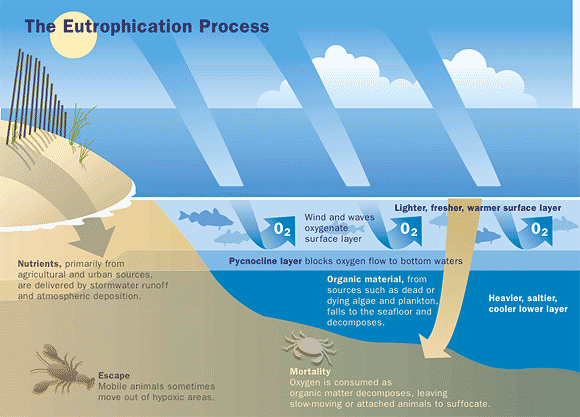
How Healthy Lakes Slowly Turn Algae-Dominated
In the early stages, eutrophication is easy to miss. The water may still look clear, and algae blooms might appear only briefly or only during certain seasons. As nutrient levels continue to rise, the changes become more noticeable.
Algae blooms happen more often. Water clarity starts to decline. String algae appears along shorelines, and surface scum shows up during warm conditions. At that point, algae control often becomes a regular and expensive part of managing the waterbody.
From Algae Blooms to Ecosystem Stress
As algae growth increases, the effects go beyond appearance. Excess algae creates a chain reaction of water quality problems that affect the entire ecosystem.
Oxygen Loss
When algae die, bacteria break them down, and that process consumes dissolved oxygen in the water. Lower oxygen levels can stress fish, eliminate beneficial organisms, and cause sudden oxygen crashes, especially overnight.
Harmful Algae Blooms
Eutrophication also increases the likelihood of harmful algae blooms, including cyanobacteria. These blooms can pose risks to people, pets, and wildlife, which adds another layer of concern for lake managers and property owners.
Biofilm Expansion
Nutrient-rich water supports the expansion of biofilm. Biofilm allows algae to attach to sediments, rocks, and infrastructure, which makes regrowth easier and more persistent over time.
Why Traditional Algae Control Often Fails
In systems affected by eutrophication, algae are not the root problem. They are a symptom. Traditional algae control methods often focus on removing what is visible, usually with chemical treatments.
While those treatments can reduce algae in the short term, the nutrients that caused the growth remain in the system. Algae return quickly, treatment frequency increases, and long-term costs rise without meaningful improvement in overall water quality. This is why many lakes require constant algae treatment without lasting results.
Breaking the Eutrophication–Algae Cycle
Breaking the cycle requires a different approach. Long-term management focuses on limiting algae reproduction instead of reacting after blooms appear.
Effective strategies work to suppress photosynthesis, reduce biofilm accumulation, stabilize dissolved oxygen patterns, and support broader nutrient management efforts. This shift explains why non-chemical algae treatment methods are being used more often in eutrophic waters.
Chemical-Free and Sustainable Algae Control
The spread of eutrophication has increased interest in chemical-free algae control solutions that operate continuously rather than in short bursts.
These approaches reduce reliance on algaecides, support gradual improvements in water clarity, and align with environmental and regulatory goals. They are especially useful in situations where nutrient inputs cannot be eliminated right away.
Ultrasonic Algae Control in Eutrophic Lakes
One method that has gained wider adoption is ultrasonic algae control. Ultrasonic water treatment uses targeted sound frequencies to interfere with algae photosynthesis and limit reproduction in nutrient-rich conditions. Over time, it can also reduce biofilm development.
While this type of treatment does not remove nutrients from the water, it helps prevent those nutrients from turning into algae, which interrupts the bloom cycle.
Why Recovery Takes Time
It is important to recognize that recovery takes time. Eutrophication usually develops over decades, and improvement does not happen overnight.
Progress is better measured by reduced bloom frequency and severity, clearer water from one season to the next, more stable oxygen levels, and less dependence on emergency algae treatments. Sustainable improvement is the marker of effective eutrophication management.
Final Thoughts
When lakes deteriorate, eutrophication is often the underlying reason. Algae blooms are simply the most visible sign of a deeper imbalance driven by nutrient accumulation and biological feedback.
Addressing that imbalance means moving away from short-term fixes and toward long-term, chemical-free strategies that support healthier water over time.

.svg)