24/7 targeted ultrasound
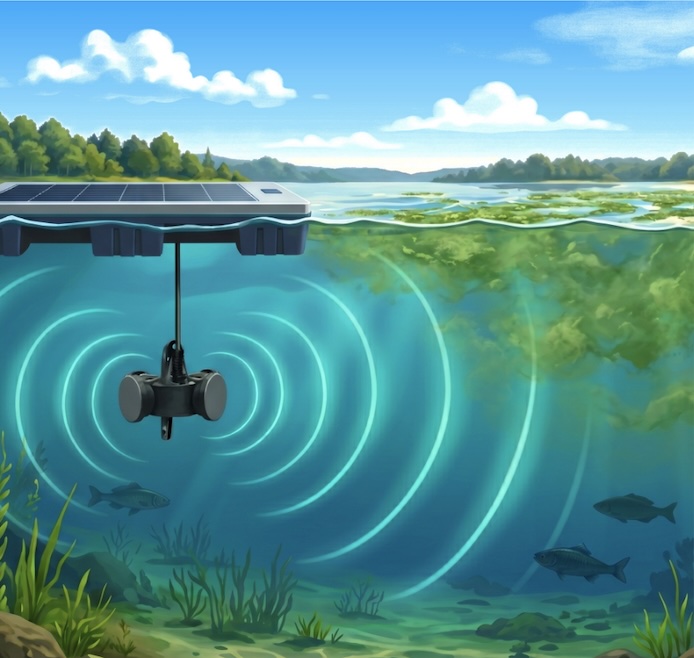
The Pulsar 4400 emits targeted sound waves in a 360° pattern.

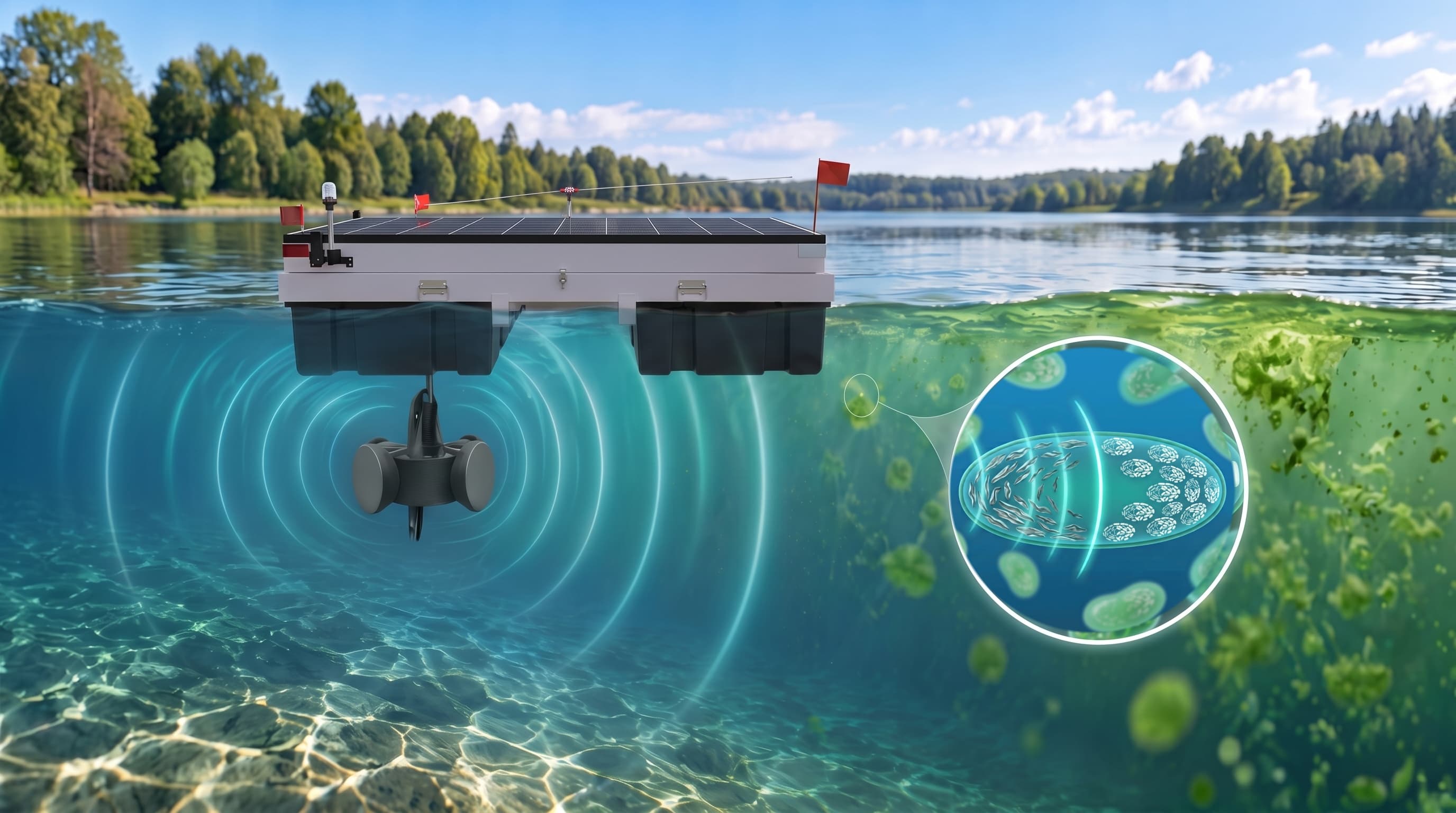
What happens when targeted ultrasonic frequencies work continuously against the structures cyanobacteria depend on to grow and dominate the water
Controlling a cyanobacteria bloom begins at the cellular level. Cyanobacteria, commonly called blue-green algae, depend on microscopic structures that regulate buoyancy, support photosynthesis, and give them a competitive advantage in the water column. Targeted ultrasound disrupts those structures and functions continuously without adding chemicals to the water.
Continuous treatment changes the way cyanobacteria can be managed. Instead of waiting for a bloom to reach problem levels and then responding with another treatment, ultrasound works 24 hours a day to combat active cyanobacteria and suppress future bloom growth.
Gas vesicles are a key target in bloom-forming cyanobacteria.
Many cyanobacteria use microscopic gas vesicles to regulate buoyancy. These structures keep the cells in favorable positions in the water column, where they reach the light needed for photosynthesis and gain an advantage over competing organisms.
Targeted ultrasound disrupts those gas vesicles. Critical Structural Resonance does not break the cell’s outer wall. Instead, it causes the rigid, single-protein-layer walls of the gas vesicles to flex repeatedly until they fracture, much like breaking a plastic drinking straw by bending it back and forth. Once the vesicles collapse, the cells become denser and sink into deeper water, where reduced light limits photosynthesis and the cells progressively lose viability. Ultrasound also affects photosynthetic activity, cell and colony morphology, and other cellular functions involved in growth and bloom formation.
The Pulsar 4400 emits targeted sound waves in a 360° pattern.
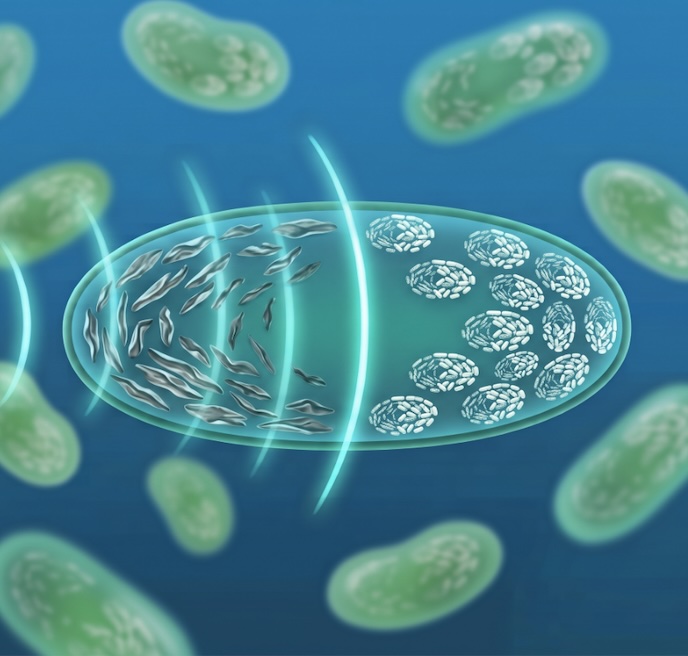
Gas vesicles and other cellular structures are disrupted, impairing buoyancy and function.
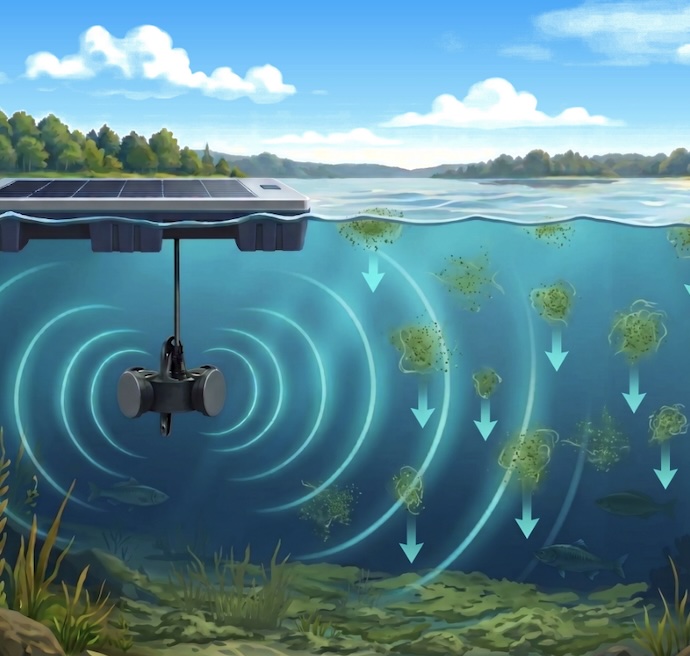
Cyanobacteria sink out of the light needed for photosynthesis. Cells die gradually and toxin levels diminish over time.
Key advantage: gradual natural die-off avoids the sudden toxin release associated with rapid chemical kills.
Many laboratory ultrasound studies use high intensity to create cavitation, the rapid formation and collapse of microscopic bubbles. Cavitation physically damages cells, but the effect is concentrated close to the source and requires much higher energy.
Open-water algae control uses a different approach. Targeted multi-frequency ultrasound operates below cavitation conditions and disrupts vulnerable cellular structures and biological functions through specific frequencies rather than trying to rupture cells with brute force.
That difference matters with cyanotoxins as well. SonicPure ultrasound does not depend on suddenly lysing cyanobacteria cells. The cells decline gradually as their buoyancy and other functions are disrupted. At Sylvan Lake, Ohio, microcystin concentrations declined continuously as the bloom came under control, eventually reaching the analytical detection limit. At Lakes Tres Pascualas and Vichuquén in Chile, microcystin-LR declined during treatment until it fell below the detection limit, and therefore below the WHO short-term guideline value for recreational waters.
As more cyanobacteria are affected, the change becomes visible at the population level. Cell abundance falls, colonies become smaller or break apart, and cyanobacteria lose the advantages that allowed them to dominate the water.
Across field applications we have evaluated in lakes, reservoirs, aquaculture ponds, and industrial water systems, the same pattern appears repeatedly. Most of the monitored systems compiled in our research showed reductions exceeding 50% in the dominant cyanobacteria.
At Lake Lo Méndez in Chile, Microcystis aeruginosa declined 99% after eight weeks of treatment. In a University of Florida mesocosm study at Lake Okeechobee, Florida, phycocyanin declined 66% after approximately five weeks of ultrasound treatment while the untreated control increased 34%. In Ecuador aquaculture ponds, dominant Oscillatoria and Raphidiopsis declined 91% after 14 weeks.
Lower cell counts are only part of the story. As the bloom comes under control, the changes become visible in the water and translate into fewer bloom-related problems for the people managing it.
As cyanobacterial biomass declines, suspended material falls and water clarity improves.
At Lake Lo Méndez, mean water transparency increased from approximately 0.8 meters at the start of treatment to about 1.4 meters after four months. At Lake Tres Pascualas, mean water transparency increased from approximately 0.7 meters to 0.92 meters between the beginning and end of monitoring.
We also see changes in the phytoplankton community. As cyanobacteria lose dominance, diatoms, green algae, cryptophytes, and other phytoplankton groups become more prominent. Across the systems evaluated in our research, species richness and diversity generally increased as cyanobacterial dominance declined.
For water managers, the practical outcomes matter most: clearer water, fewer visible blooms, reduced reliance on chemical treatments, less algal biomass entering drinking-water treatment, and less fouling in aquaculture and industrial applications.
Ultrasonic algae control has also been evaluated for its effects on non-target organisms.
A Cornell University-led study exposed seven fish species directly to ultrasonic algae-control devices and found no behavioral, morphological, or histological changes. Field monitoring at Oneida Lake found no difference in fish distribution or behavior when the devices were operating compared with when they were turned off. Research on farmed sturgeon, salmon, and shrimp, on zooplankton, and on waterbirds has likewise found no direct harm from ultrasound.
Chemical treatments are isolated events, allowing cyanobacteria to continue growing between applications. Ultrasound changes that equation by operating continuously.
The Pulsar 4400 works 24/7, combating active algae and cyanobacteria while suppressing future growth. It adds no chemicals to the water and reduces reliance on repeated chemical treatments.
At La Poza Bay in Lake Villarrica, Chile, treatment over two consecutive summers showed both sides of continuous control. In the first season, Dolichospermum declined 53% and Microcystis 33%. In the second season, preventive operation kept cyanobacteria at low levels and prevented new blooms from developing, despite higher surface water temperatures.
Ultrasound does not remove phosphorus or stop new nutrient runoff from entering a water body. Those issues still need to be managed where appropriate. Ultrasound controls the algae and cyanobacteria that use those conditions to form blooms. Treatment has also not been associated with increased phosphorus release from sediments. No increase was observed in a heavily sedimented 1.4-hectare pond in Mt. Pleasant, South Carolina, or in Lakes Tres Pascualas, Lo Méndez, and Vichuquén in Chile.
For lake managers, utilities, aquaculture operators, and industrial facilities, that means active blooms can be addressed now while broader nutrient-management and restoration work continues. Rather than repeatedly reacting after cyanobacteria reach problem levels, continuous ultrasound keeps treatment pressure on the growth around the clock.
Contact SonicPure to discuss how continuous ultrasound can control cyanobacteria in your lake, reservoir, aquaculture pond, or industrial water system: sales@sonicpure.com or +1 (310) 955-4005.
See SonicPure case studies for more examples of algae and cyanobacteria control in the field.
Sources
1. Almanza, V., and G. Hutchinson. In preparation. “Ultrasound Technology for Cyanobacteria Control.” Chapter manuscript for Nature-Based Solutions for Cyanobacterial Bloom Control, edited by Laila Mandi, Vitor Vasconcelos, Brahim Oudra, and Pedro Carvalho.
2. Getchell, R.G., E. George, A.N. Rice, J.M. Malatos, B.M. Chambers, A. Griefen, C. Nieder, and L.G. Rudstam. 2022. “Effects of Ultrasonic Algal Control Devices on Fish.” Lake and Reservoir Management 38 (3): 240–255.
3. Laughinghouse, H.D. IV. 2023. The Effect of Ultrasound Treatment on Numerical Density and Physiological State of Trophic Levels in Lake Okeechobee, Florida. Unpublished research report. University of Florida/IFAS, Fort Lauderdale Research and Education Center.
4. World Health Organization. 2021. Guidelines on Recreational Water Quality. Volume 1: Coastal and Fresh Waters. Geneva: World Health Organization.